泌乳期乳腺炎護理(Care and Management of Lactational Mastitis)
【Key Learning Points】
- Definition: Lactational mastitis is a localized breast infection that most frequently occurs within the first six weeks postpartum.
- Complications: Without proper management, the condition may progress to a breast abscess.
- Prevention: Prevent nipple trauma; vary breastfeeding positions; avoid tight-fitting bras.
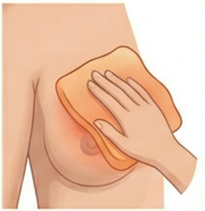
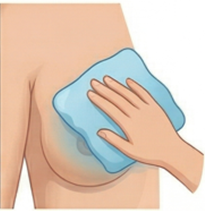
- Symptom Relief: Apply cold compresses between feedings for pain; use warm compresses before feeding to facilitate milk flow.
- Hotline: For concerns,
call 04-23592525 ext. 8176 (24h) or ext. 6547.
|
Lactational mastitis is an inflammatory condition often triggered when breast engorgement or blocked ducts are not effectively resolved. Studies indicate that 1 in 5 breastfeeding women may develop mastitis, typically during the first six weeks postpartum
| 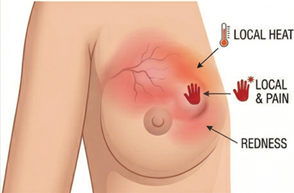 Image source: Generated by AI |
II.Common Causes
- Early
Postpartum Phase
- Improper latch or poor/uncoordinated infant suck.
- Infrequent breastfeeding or adherence to strict schedules.
- Nipple
trauma leading to bacterial entry.
- Established Breastfeeding Phas
- Oversupply of milk.
- Delayed milk expression due to illness.
- External pressure on ducts (e.g., tight bras).
- Nipple complications (fungal infections/wounds).
- Ineffective infant sucking.
III.
Symptoms
Signs include a localized lump, pain, redness,
swelling, and warmth in the breast. Systemic symptoms may include a fever
(>38.5°C), chills, and flu-like exhaustion.
IV.Self-care
Strategies:Frequent and effective milk removal is
the cornerstone of treatment.
|  |  |
|
Before feeding: warm compress(5min,41-43℃
)
|
After feeding: cold compress(5min) | |
| Image source: Generated by AI | ||
V.
Medical Treatment
|
Breast milk remains safe for infants during mastitis, though its taste may temporarily change. If prescribed, follow the full course of antibiotics. Consult an Obstetrics and Gynecology if symptoms do not improve within 12–24 hours
| Fever >38.5℃ 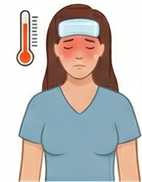 |  |
Continue Breastfeeding
 |
| No improvement in 12-24hrs |
Follow doctor's antibiotic advice
| ||
| Image source: Generated by AI | |||
VI.References
- Blackmon, M. M., Nguyen, H., Vadakekut, E. S., & Mukherji, P. (2024). Acute mastitis. In StatPearls. StatPearls Publishing. https://www.ncbi.nlm.nih.gov/books/NBK557782/
- Xing, J., & Zhu, Y. (2025). Progress in treatment of acute mastitis with traditional Chinese and Western medicine. Traditional Chinese Medicine, 14(5), 2223–2229. https://doi.org/10.12677/tcm.2025.145331
Short quiz
Let's take a test to confirm that you have a thorough understanding.
評語
統計結果不開放
請登入後才可以評分
未登入或權限不足!
- 位置
-
- 資料夾名稱
- 產科
- 上傳者
- 紀妍菲
- 單位
- 中榮護理衛教
- 英文名稱
- Care and Management of Lactational Mastitis
- 分類
- 疾病
- 科別
- 英語
- 癌症照護
- 否
- 建立
- 2026-04-09 16:18:01
- 最近修訂
- 2026-06-25 16:23:59